
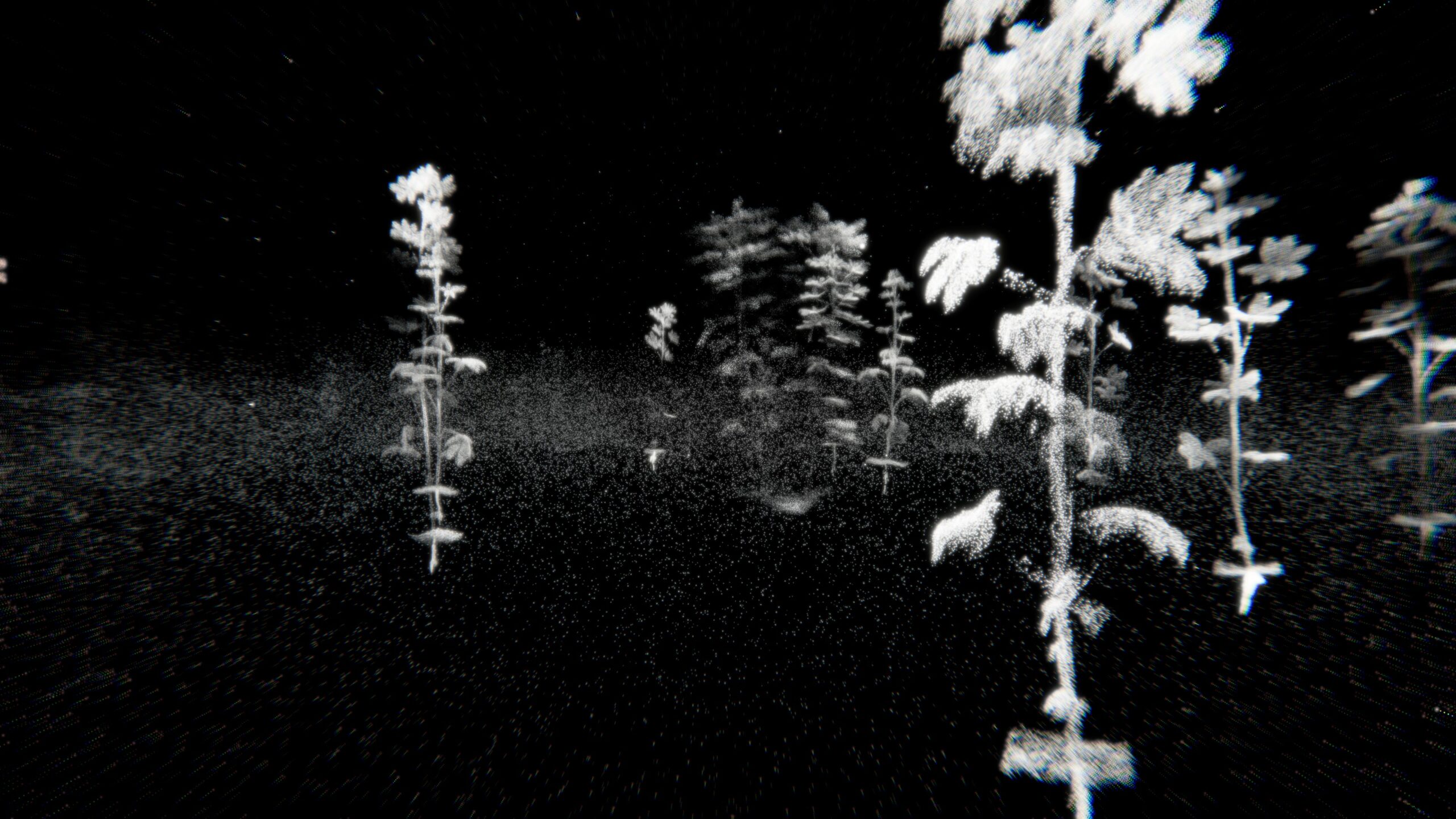
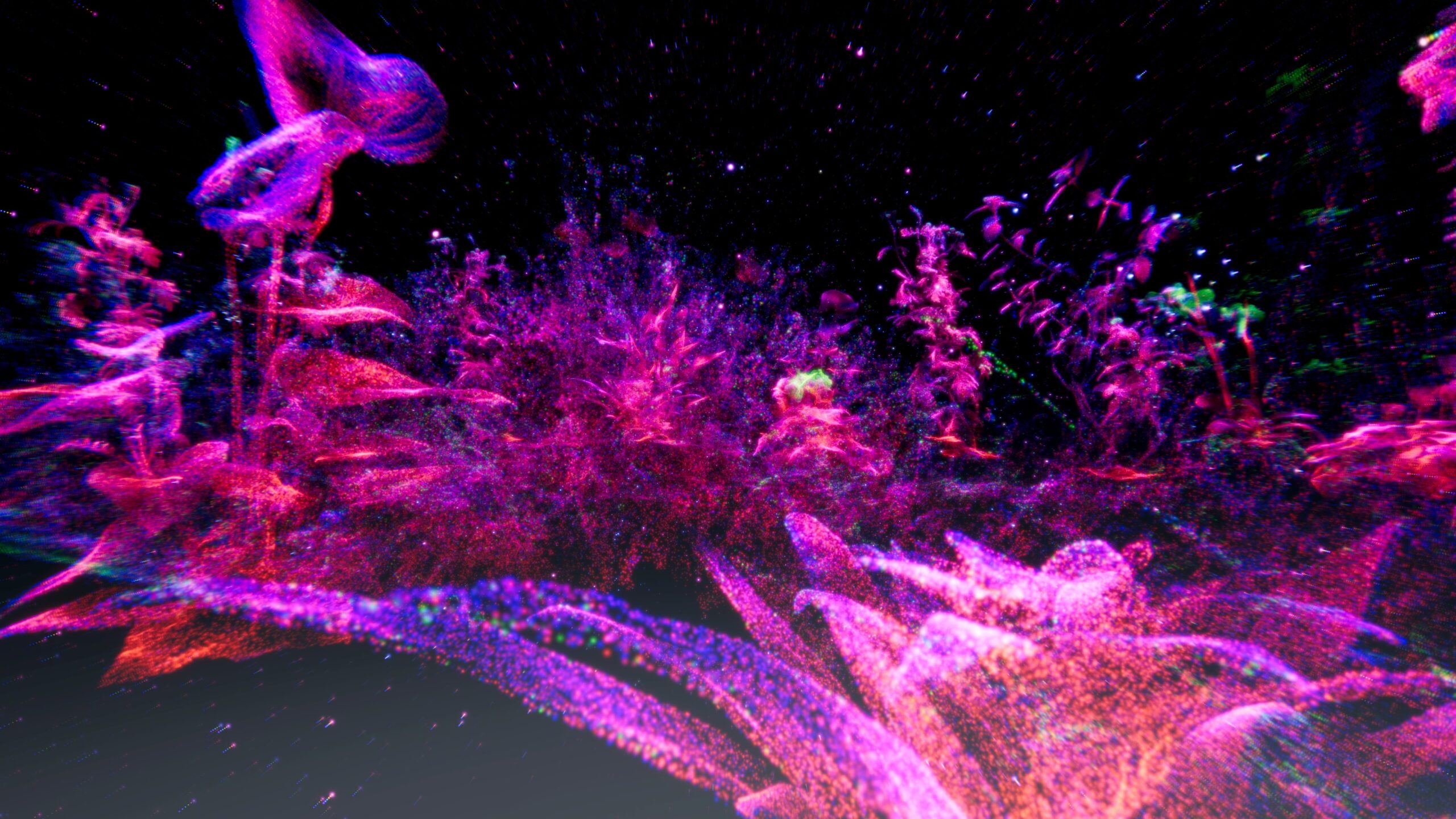
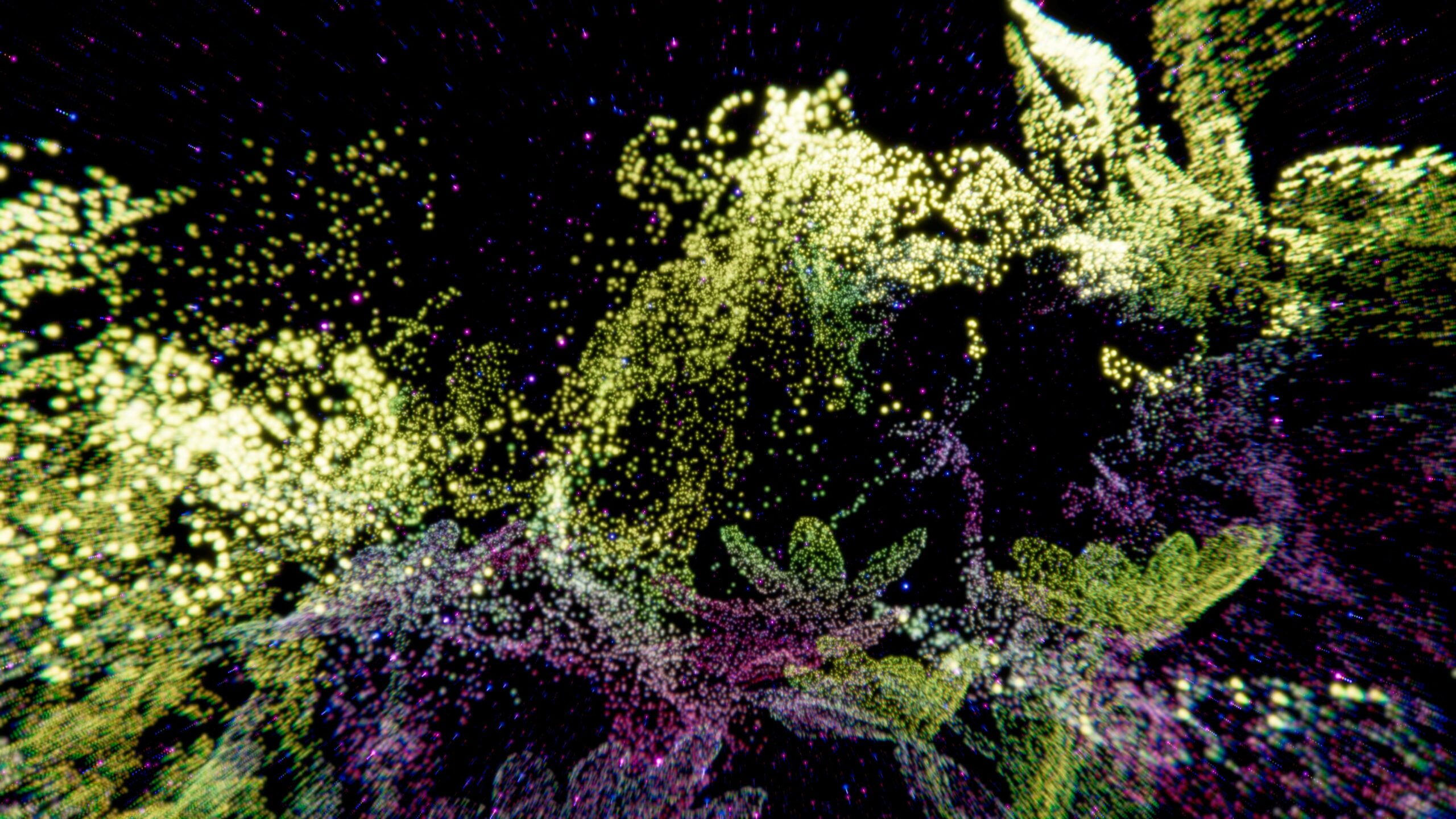
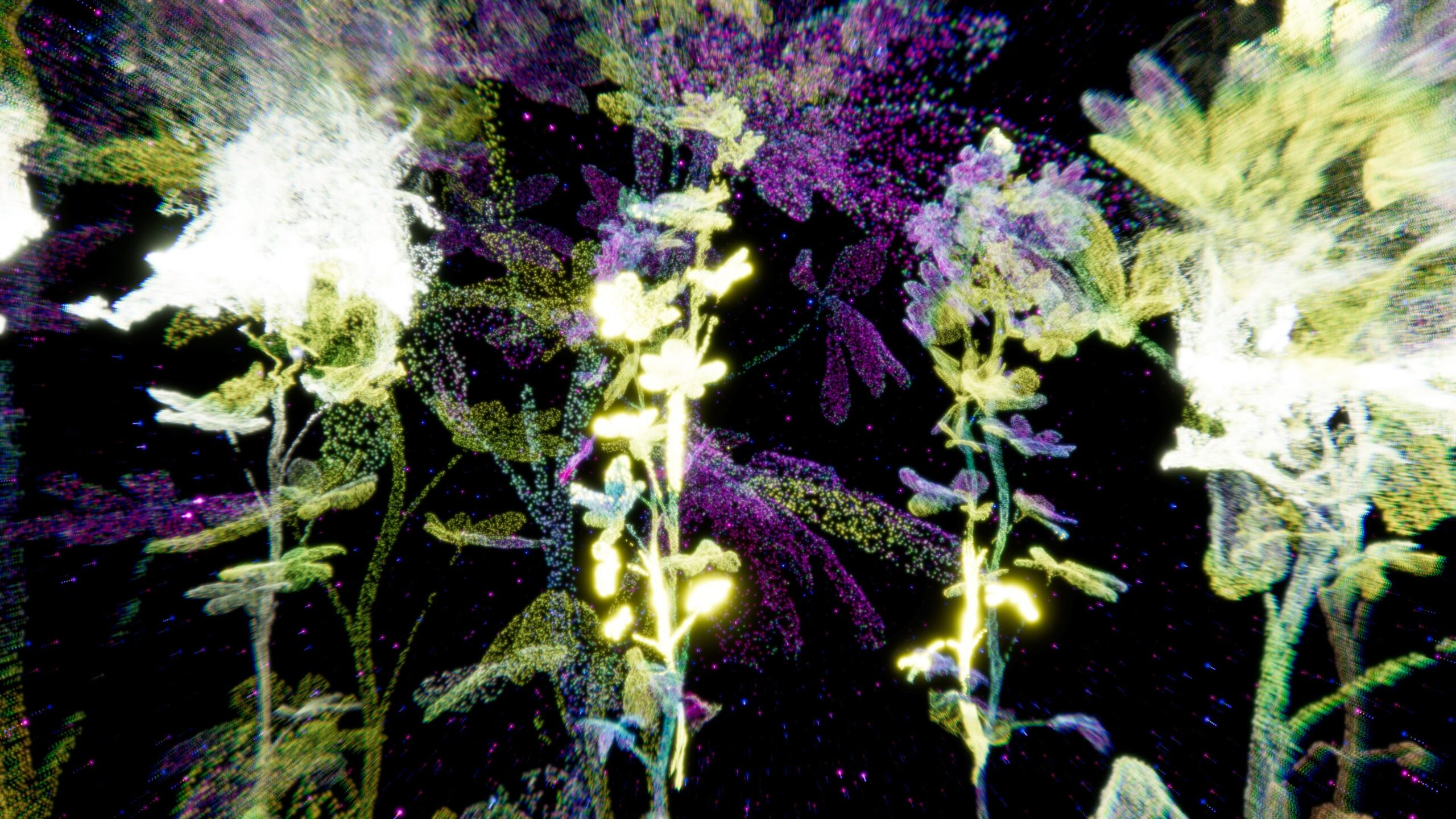
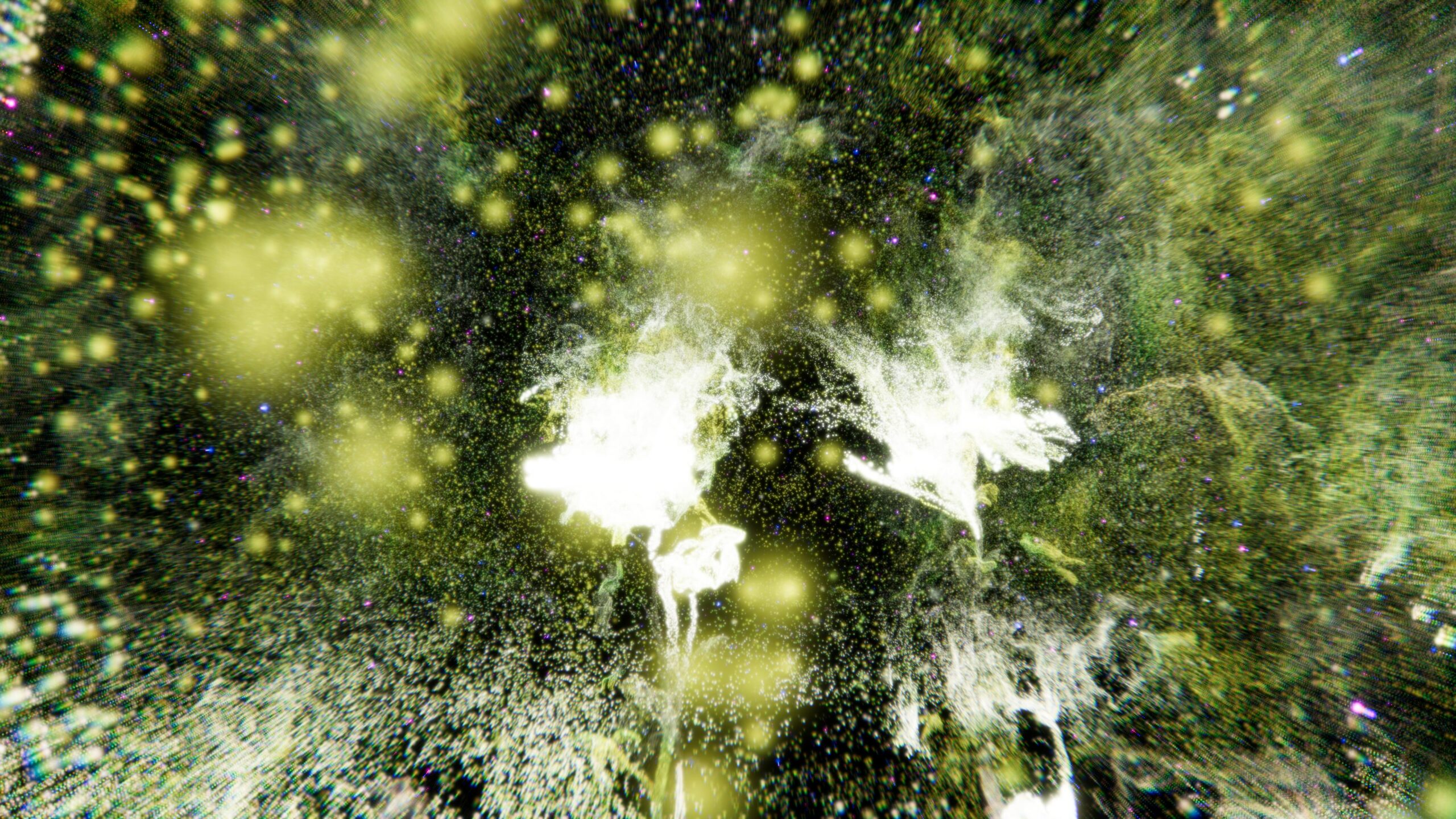
3D-captured lupin plants at different growth stages from the Light-Sensing Experiment (see Chapter 3) are used as main “actors,” together with environmental data, in the Solarceptors virtual reality environment.
The viewer is immersed in the self-invented existence of flowering plants that use light sensing as a key strategy to survive and thrive.
Flowering plants are explored artistically as light-sensing beings, suggesting that they use light for more than survival. Beyond photosynthesis—transforming “thin air” into matter—plants engage with light as a medium of connection, relating to their surroundings in multiple visible and invisible ways. Their flowers, unfolding in diverse colors and forms, reflect a high capacity for survival, yet their interaction with light extends far beyond this.
By rethinking flowers as antennas and attractors—not only for insects and humans, but also for light—Solarceptors artwork envisions flowering plants as spatiotemporal manifestations of light in interplay with solar cycles...
Solarceptors is an immersive VR experience based in research on flowering plants and how they sense, respond to, and interpret light—creating their own existence and shaping the worlds they inhabit. Beyond their major evolutionary invention of photosynthesis—transforming “thin air” into matter—plants use light to connect with their surroundings in visible and invisible ways. The diverse colors and spectacular forms of flowers suggest that their relationship to light—while key to survival—extends far beyond it.
To explore flowering plant light-sensing capacities and their intelligent responses to light—expressed, following biologist Anthony Trewavas, through “adaptively variable growth and development” during the lifetime of an individual plant—an artistic experiment was carried out as a first step. Scientific experiments by plant ecologist Katja Tielbörger at the University of Tübingen on plant “decision-making” served as inspiration for a further artistic experiment. It was adapted by the artists by growing flowering plants under green and multicolored light filters simulating different growth conditions and light competition. It was conducted at the Swiss Research Institute for Organic Agriculture FIBL, which contributed to selecting the plant species—white lupin—based on their research into adapting this crop to Swiss climate conditions, thus making white lupin a suitable species for this experiment.
Time-lapse cameras and environmental sensors measuring humidity, air temperature, and PAR (photosynthetically active radiation) were installed to monitor climate conditions throughout the growing season. The plants were 3D-scanned across multiple stages of growth and development. As a result, the digitally captured 3D plants—revealing individual forms shaped by light sensing and complex decision-making across their lifespan—became the “actors” of a virtual reality journey that invites viewers to encounter the self-invented world of flowering plants and their transformations within light.
Building on these experiments, data, and observations, the research is translated into a poetic and visionary VR experience, Solarceptors, which reimagines flowers as sensitive light bodies. The immersive experience unfolds across five episodes, beginning over one hundred million years ago, when flowering plants rapidly diversified into an astonishing array of forms and colors—an evolutionary phenomenon Darwin famously described as the “abominable mystery.” Further episodes with 3D captured lupin plants in their different stages of development emphasize modular growth and individual “decisions” they make in relation to the environment, visualized using data from the light-sensing experiment.
The journey then reveals flowers as light-sensitive organisms that not only harness light for photosynthesis—transforming light energy into matter and concentrating it into flowers—but also shape diverse forms that reflect light and unfold color, expressing extraordinary plasticity and aesthetics beyond mere resilience.
The VR experience concludes with an artistic speculation on the spatiotemporality of flowers—tracking the sun, synchronizing circadian rhythms with planetary cycles, and ultimately becoming light themselves.
Credits:
Artwork: Rasa Smite and Raitis Smits.
Research framework: Plants Intelligence. Learning Like a Plant (2022–2025), funded by the Swiss National Science Foundation, hosted by the Institute for Art, Gender, and Nature, Basel Academy of Art and Design FHNW, led by Yvonne Volkart (PI), with research by Rasa Smite.
Scientific partners: Katja Tielbörger (University of Tübingen); FiBL—Swiss Organic Farming Research Institute: Christine Arncken, Mariateresa Lazzaro, Monika Messmer.
VR programming: Kristaps Biters.
Music and Sound: Lauris Smits.