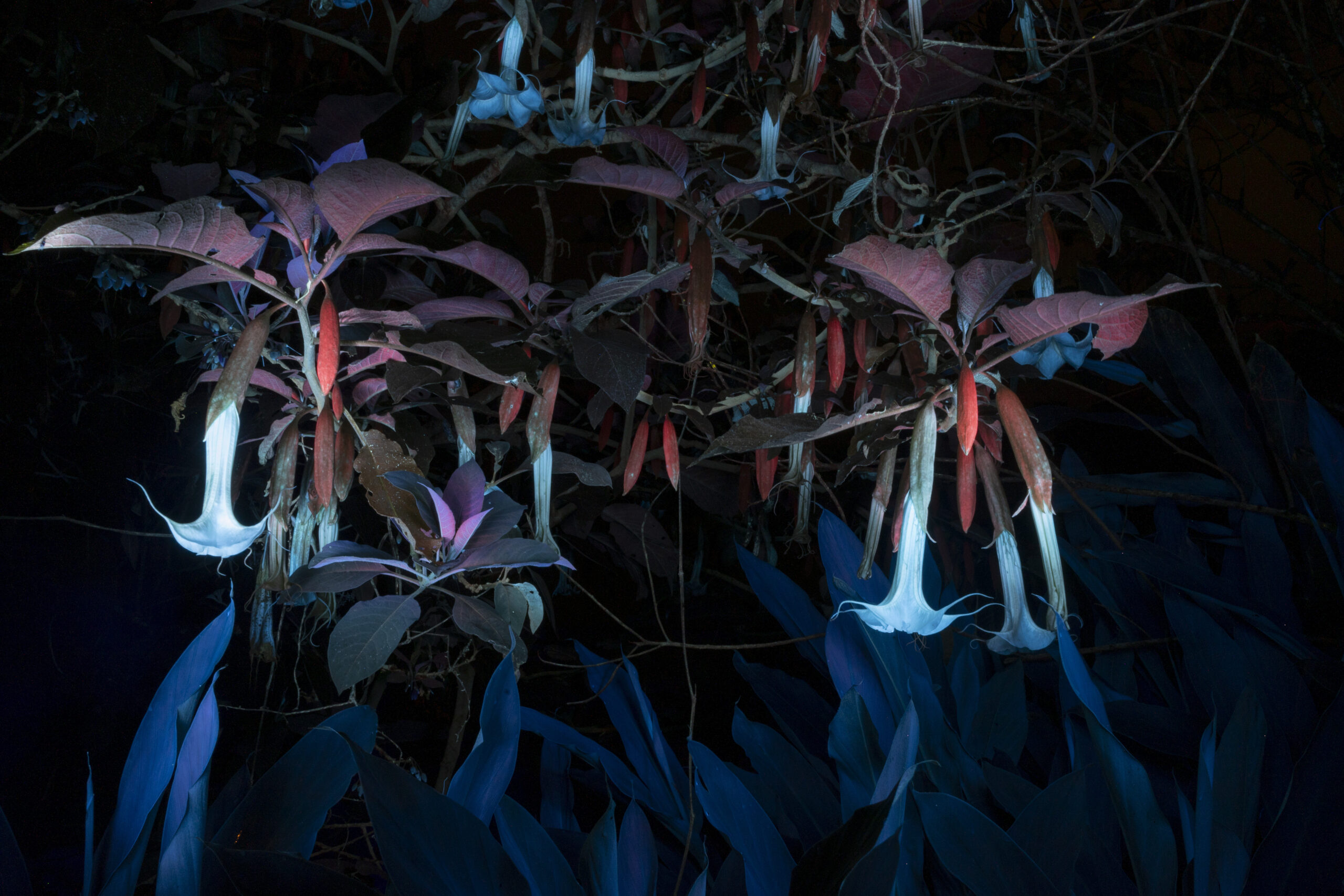
Borrachero Andaki
From the Solanaceae family, the Borrachero Adaki (or Culebra) is a variety of the Brugmansia plant form the high Andes and humid rainforest of Colombia, thought to be a cultigen because its presence is most often related to human settlements where the plant has been cultivated. In 1942, Richard Evan Schultes encountered this rare variety of the Burgmansia plant. Its leaves narrower, resembling a knife and “the corolla almost divided into separate petals united only towards their bases.”
He named this variety Methysticodendron Amesianum [the Mutant Sleep Tree], or also known as Borrachero Culebra.
Richard Evans Schultes, “A NEW NARCOTIC GENUS FROM THE AMAZON SLOPE OF THE COLOMBIAN ANDES.” Botanical Museum Leaflets, Harvard University 17, no. 1 (1955): 1–11.
See term
Buen vivir
Good Living is an old-new paradigm based on the indigenous concept of Sumac Kawsay. It is a concept in collective construction in Latin America that seeks alternatives to the Western idea of development, linking indigenous traditions and worldviews with critical ideas within Western modernity. Buen vivir proposes to abandon the idea of development as unlimited economic growth and to substitute it for a supportive and sustainable economy, displacing the centrality of humans, recognizing the centrality and value of nonhumans, and the rights of Nature.
Mónica Chuji, Grimaldo Rengifo, and Eduardo Gudynas, “Buen Vivir,” in “Pluriverse. A Post-Development Dictionary”, eds. A. Kothari, A. Salleh, A. Escobar, F. Demaria & A. Acosta, (Tulika & Authors Upfront, New Delhi, 2019), 112.
See term
Plasticity
Plasticity is an individual plant response to the environmental change as it is called in ecology and evolution studies. According to the view of natural scientists (such as Trewavas), the “intelligent behavior” by plants shows rather during their individual life time scale, and that this process is not an evolution.
See term
Resistant weeds
Term given by industrial agriculture to spontaneous vegetation resistant to agrochemicals used in transgenic monocultures.
See term
Senti-pensar
Eduardo Galeano once said that our society often separates our soul from the body and mind from heart. To avoid this, Galeano proposed the concept of "senti-pensando" which means feeling-thinking. He learned this wisdom from Colombian fishermen who created the word "sentipensante" to describe language that speaks the truth.
Eduardo Galeano, "The book of embraces,” Trans. Cedric Belfrage, ed. W.W. Norton, (New York, 1991), 221.
See term
Weeds
Over 50 years ago, biologist Edwin R. Spencer stated that “any plant is a weed if it insists on growing where the farmer wants another plant to grow. It is a plant that is out of place, according to one person's judgment, but according to the good judgment of nature it is perfectly in its place.”
Edwin Rollin Spencer, in “Malezas comestibles del Cono Sur y otras partes del planeta," E. H. Rapaport, A. Marzocca, S. B. Drausal, (Instituto Nacional de Tecnología Agropecuaria, Universidad Nacional del Comahue, Bariloche, 2009), 3.
See term